
KnowAct-GUIClaw: Know Deeply, Act Perfectly
Lychee Team, RICI, Harbin Institute of Technology, Shenzhen
Personal GUI assistant with self-evolving memory and skill for long-horizon, cross-application GUI workflows.
Abstract
Know deeply,Act perfectly.
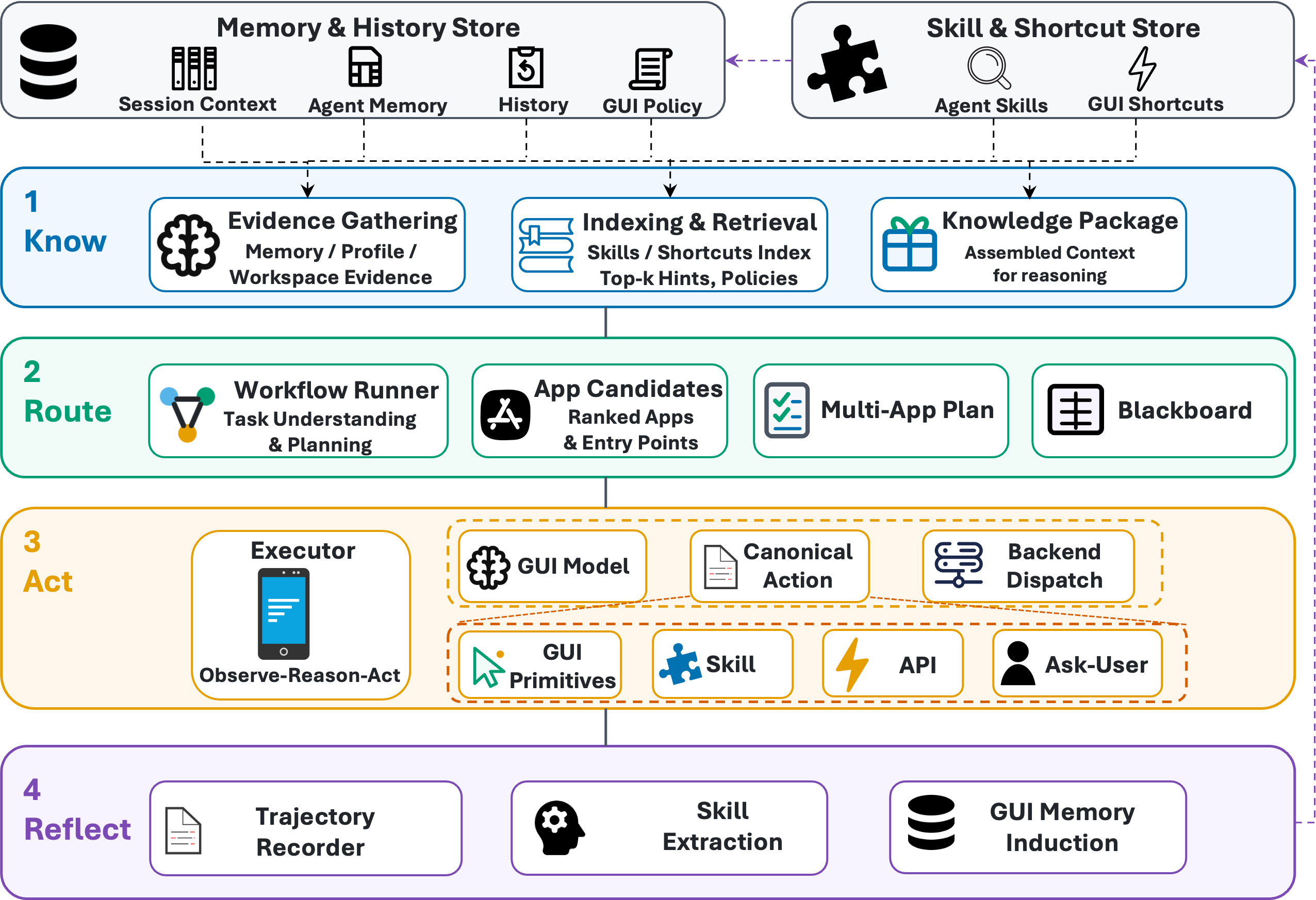
KnowAct-GUIClaw is a Know-Route-Act-Reflect framework for personal GUI assistants. It turns accumulated interaction experience into better task decomposition, cross-platform GUI execution, and self-evolving memory and skills. Guided by the Know Deeply, Act Perfectly paradigm, the system connects what the assistant knows with how it acts across Android, iOS, HarmonyOS, and Windows.
Extensive cross-platform experiments validate our model's leading UI manipulation precision and cross-system generalization. GUIClaw + open-source Kimi-2.6 achieves a state-of-the-art 64.1% on the long-horizon MobileWorld benchmark, outperforming all open agent frameworks and closed agents (Seed-2.0-Pro, GPT-5.5). The framework's knowledge memory and execution capabilities generalize to various base models: +8.5% on Kimi-2.6 and +16.2% on Qwen3.5-35B-A3B.
Architecture
Know-Route-Act-Reflect in one loop.
The framework routes long-horizon tasks from high-level intent to executable GUI actions, then feeds execution traces and feedback back into memory and skills.
Evaluation
Designed for efficient long-horizon GUI workflows.
The leaderboard summarizes MobileWorld GUI-only success rates. The same values appear in Table 1 of the technical report; the bar chart is used here for faster visual comparison on the project page.

Case Study
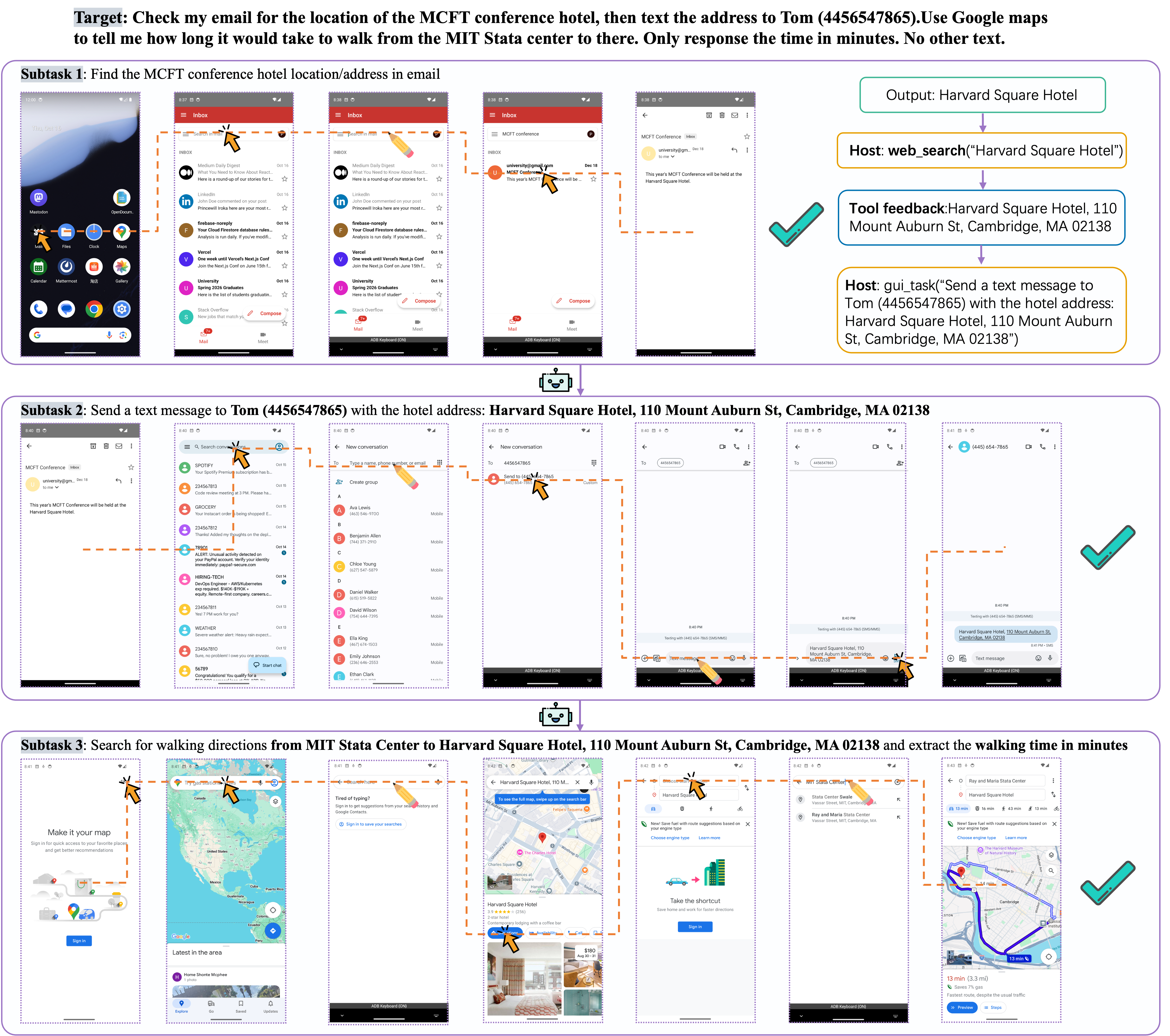
Multi-task tool and GUI collaboration.
A representative case shows how KnowAct-GUIClaw combines tool use, GUI interaction, and task progress tracking in a unified execution flow.
Demos
Interactive demos.
Citation
Cite the technical report.
@misc{li2026knowactguiclawknowdeeplyact,
  title={KnowAct-GUIClaw: Know Deeply, Act Perfectly, Personal GUI Assistant with Self-Evolving Memory and Skill},
  author={Yunxin Li and Jinchao Li and Shibo Su and Zhenran Xu and Chenrui Zhao and Tongshu Bian and Xiaoman Liang and Meishan Zhang and Baotian Hu and Min Zhang},
  year={2026},
  eprint={2607.12625},
  archivePrefix={arXiv},
  primaryClass={cs.CL},
  url={https://arxiv.org/abs/2607.12625},
}